
The Material Grade Most B2B Buyers Never Check
Why Your Trimmer Line Keeps Breaking: The Material Grade Most B2B Buyers Never Check
Shape and diameter are secondary. Material is primary. After 19 years supplying OPE parts across 20+ countries, here's the grade breakdown every distributor needs — and why "100% nylon" on a spec sheet is nearly meaningless.
We asked one question: What's the polymer?
Silence.
Here's the thing nobody tells you in trimmer line sourcing: shape and diameter are secondary. Material is primary. You can buy the perfect square profile in the exact right gauge, and if the polymer is wrong, your line still fails. It frays. It welds inside the head. It snaps on the first fence post.
After 19 years supplying OPE (Outdoor Power Equipment) parts to distributors across 20+ countries, we've seen every grade on the market. This guide breaks down the three that actually matter — and why "100% nylon" on a spec sheet tells you almost nothing.
The Problem with "100% Nylon"
"Nylon" is a family name, not a material spec. It covers PA6, PA66, PA12, and dozens of copolymer variants — and they perform very differently under a trimmer head spinning at 7,000+ RPM.
Two lines can both be honestly labeled "100% nylon" and have completely different breaking points, melting thresholds, and wear rates. Worse, many suppliers blend in recycled regrind to cut cost. The spec sheet says nylon. The field says otherwise.
So the real question isn't "is it nylon?" — it's "which nylon, from which polymer source, and is it virgin or blended?"
A spec sheet that reads "100% nylon" without identifying the specific polyamide grade, polymer source, and virgin/blended ratio is not a specification — it's a marketing label. Professional sourcing demands material-level transparency.
The Three Material Grades That Matter
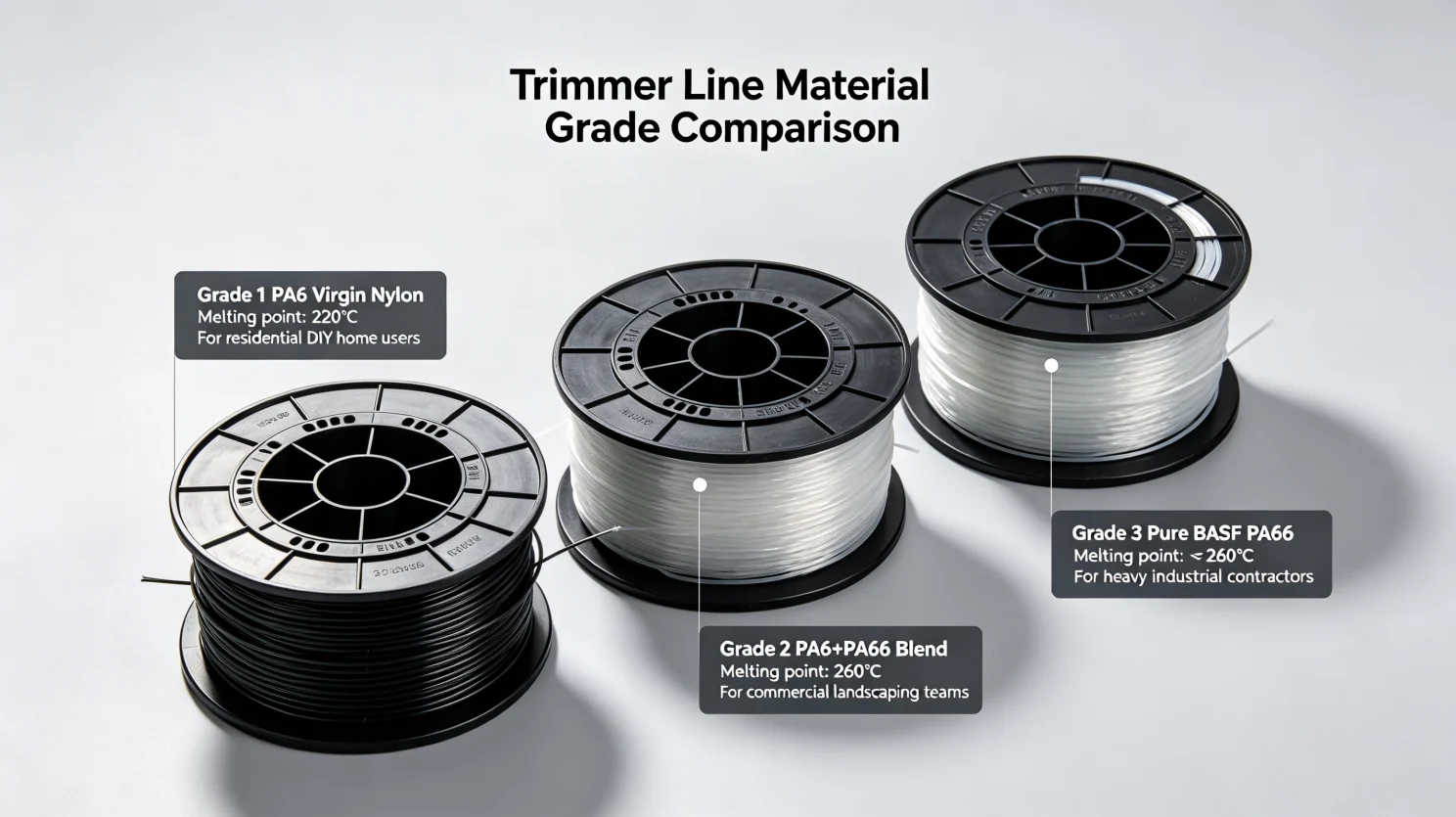
Here's how we grade trimmer line material — from standard residential to full industrial spec.
PA6 has a melting point around 220°C, good flexibility, and reliable tensile strength for the price. This is the workhorse grade — the most widely used trimmer line material on the global market.
✓ Where It Wins
Budget-conscious markets, big-box retail volume, residential DIY. If your end user mows a suburban lawn once a week, PA6 is more than enough.
✗ Where It Loses
Continuous commercial use. Under sustained high-RPM friction, PA6's lower melting point means it can soften and weld inside the trimmer head — the dreaded "line sticking" that jams auto-feed systems.
Buyer Takeaway
Don't sell PA6 as commercial-grade. It isn't. But for the price-sensitive segment, it's the right tool.
This is the blend most professional landscapers actually need — and most distributors don't know exists. By blending German BASF PA66 (melting point ~260°C) with PA6, you raise the thermal threshold significantly while keeping cost manageable. The copolymer matrix improves impact strength and resists the friction-welding that kills PA6 under load.
✓ Where It Wins
Mid-to-high-end landscaping services. The crew that runs a trimmer 6 hours a day, 5 days a week. This grade balances procurement budget with real-world wear resistance.
✗ Where It Loses
It's not the top tier. For contractors clearing rocky right-of-ways and woody brush all day, the blend still degrades faster than pure PA66.
Buyer Takeaway
If you're wholesaling to landscaping service companies, this should be your default — not PA6, and not the premium grade. Most buyers overspend on Grade 3 or underspend on Grade 1. Grade 2 is the sweet spot they miss.
The top of the pyramid. Pure German BASF polyamide copolymer. Melting point north of 260°C. Ultimate abrasion resistance. Maximum thermal degradation threshold.
✓ Where It Wins
Premium professional landscaping brands, heavy-duty industrial contracting, agricultural clearing where the line continuously grinds against rocks, fences, and curbing. This is the line that doesn't brittle-fracture when it hits concrete.
✗ Where It Loses
Price. Pure BASF PA66 costs 15–30% more than PA6. If your end user is a homeowner, you're burning margin on capability they'll never use.
Buyer Takeaway
Reserve this for the brands and contractors who explicitly demand it — and charge accordingly. Selling Grade 3 into residential retail is wasted money; selling Grade 1 into commercial crews is a churn risk.
Grade Comparison at a Glance
| Specification | Grade 1 — Standard | Grade 2 — Commercial | Grade 3 — Industrial |
|---|---|---|---|
| Polymer | 100% PA6 | 50% PA6 + 50% PA66 | 100% PA66 |
| Polymer Source | Sinopec (China) | Sinopec + BASF (Germany) | BASF (Germany) |
| Melting Point | ~220°C | ~240–250°C | 260°C+ |
| Weld Resistance | Low — may stick under load | High — copolymer matrix resists welding | Maximum — resists sustained friction heat |
| Abrasion Resistance | Standard | High | Ultimate |
| Cost Index | Baseline | +10–15% | +15–30% |
| Target Market | Residential DIY, big-box retail | Professional landscaping services | Premium brands, heavy industrial |
| Duty Cycle | Light / occasional | Daily commercial (6 hrs/day) | Heavy continuous (full-day grinding) |
The Real Reason This Matters for B2B Buyers
Most sourcing mistakes in trimmer line come from matching the wrong grade to the wrong market segment. Here are the three most common — and costly — errors we see:
A distributor buys Grade 1 (PA6) because it's cheap, then loses a commercial landscaping account because the line welds under daily use.
A retailer insists on Grade 3 (pure PA66) for everything, then can't compete on shelf price and the product sits.
A wholesaler buys "100% nylon" with no grade specified, gets a blended regrind batch, and fields warranty claims for an entire season.
The solution isn't buying more expensive line. It's buying the correct grade for each channel. Match Grade 1 to residential retail, Grade 2 to professional landscaping services, and Grade 3 to heavy-duty industrial — and your warranty claims, customer churn, and margin leakage all improve immediately.
How to Verify What You're Actually Buying
Spec sheets lie by omission. Here are four field tests we run on every batch — and you can run on samples:
Tensile Snap Test
Premium copolymer line stretches slightly before flexing back. Recycled-blend line snaps instantly under sudden tension.
No give = regrind inside180° Bend Test
Fold the line completely back on itself. High-quality PA6 or PA66 returns to shape with no permanent deformation. Low-grade line shows brittle white stress marks at the crease — that's the regrind failing.
White stress marks = regrind failureWeld Resistance Test
Run the line hard against a fixed surface at operating RPM, then check the trimmer head. Inferior lines melt and fuse together. BASF-based lines resist welding even under sustained friction heat.
BASF grades resist weldingDiameter Tolerance Check
Measure the line at 5 points along a spool. Precision extrusion holds tight tolerance. Wide variance means the line will jam in auto-feed eyelets — and that's a manufacturing process problem, not a material one.
Wide variance = process defectIf your supplier can't talk you through these four tests on their product, you're buying blind. A qualified OPE parts manufacturer should be able to specify polymer grade, polymer source, virgin/blended ratio, and extrusion tolerance — and stand behind it with batch-level test data.
The Bottom Line
Material grade is the single biggest lever in trimmer line performance — and the most overlooked one in B2B sourcing. Shape matters. Diameter matters. But material is the foundation. Get the grade right for your market segment, and the rest of your spec falls into place. Get it wrong, and no amount of square-edge engineering or fancy color matching will save the product in the field.
In the next article in this series, we'll break down the three line shapes — round, square, and twist — and the specific conditions where each one wins. Because once you've nailed the material, shape becomes the next performance multiplier.
Sourcing Trimmer Line for Distribution or Private Label?
Contact our team for the full grade matrix and product portfolio.
Request Full Catalog & Grade Matrix© 2026 OPE Parts Technical Sourcing. All rights reserved. | This article is part of the Trimmer Line Field Guide series for B2B distributors and sourcing professionals.