

Why the Trimmer Line Diameter in Your Catalog Is Probably Wrong for Half Your Buyers
Why the Trimmer Line Diameter in Your Catalog Is Probably Wrong for Half Your Buyers
Bigger line isn't stronger — it's shorter-lived on the wrong engine. After 19 years across 20+ markets, here's how to match trimmer line diameter to engine power, segment SKUs by power band, and stop losing accounts to the wrong default spec.
OPE Technical Sourcing Team | 19 Years Industry Experience | 20+ Countries Served
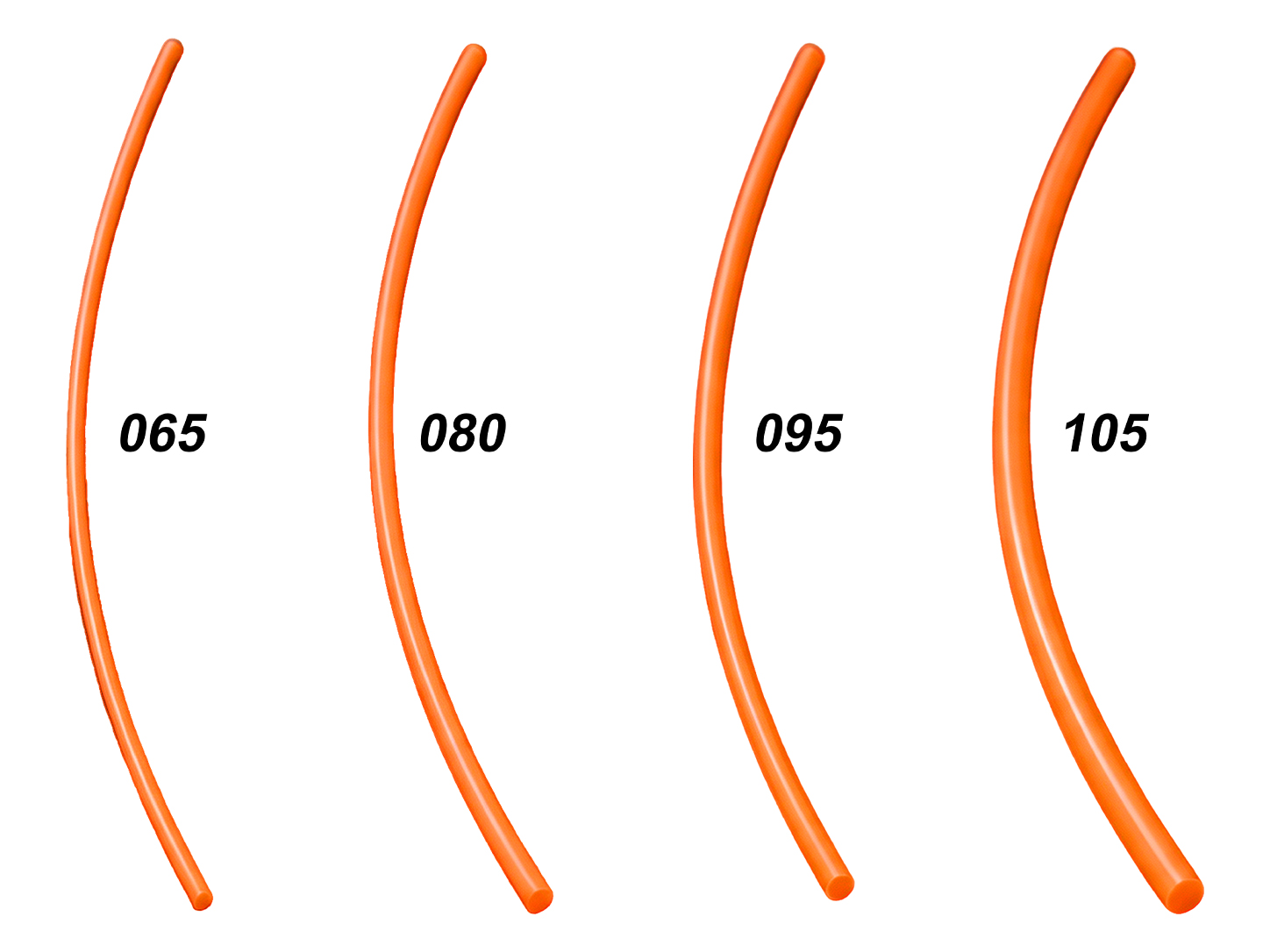
We hadn't. The material was identical.
The problem wasn't the line. The problem was the engine.
His customer had switched from selling 1kW electric homeowner trimmers to 35cc commercial gas trimmers — and was still using the .095" line his residential catalog defaulted to.
That's the diameter mistake we see every month: B2B buyers treat diameter as a generic spec, when it's actually a power-matching parameter.
Let's walk through how to think about diameter, what most catalogs get wrong, and how to match line diameter to the engine in your market — not the average across Google.
The Diameter Mistake: Bigger Isn't Stronger
This is the most counterintuitive part, and it's worth stating clearly:
A thicker line on the same engine is a shorter-lived line.
Here's why. When a trimmer head spins, each tip of line has a fixed amount of kinetic energy per revolution. If you double the diameter, you increase the line's mass per meter — but you don't double the energy the engine delivers to it.
What happens in practice:
Matched: .080" on 1kW Electric
Engine: 1kW electric homeowner trimmer
Line: .080" round
Result: Cuts clean, lasts long, low vibration. The engine comfortably drives the line at optimal tip speed.
Correct power-to-diameter match
✗
Overloaded: .130" on 1kW Electric
Engine: Same 1kW electric trimmer
Line: .130" round
Result: Engine bogs down, line whips erratically, each tip cuts less vegetation per revolution. User assumes "thicker must be better" — but line wears out faster because it's overloaded.
Engine cannot drive the line
Diameter is the maximum your engine can drive, not the minimum you should stock. Going thicker than the engine can handle doesn't make the line stronger — it makes it weaker.
The Power-to-Diameter Map
After 19 years sourcing trimmer line into 20+ countries, here's the matching table we actually use when a buyer asks "what diameter should I carry":
| Power Band | Engine Type | Power Range | RPM Range | Recommended Diameter |
|---|---|---|---|---|
| Residential Electric | Battery / Corded electric | 0.5–1.0 kW | 7,000–9,000 | .065" – .080" |
| Residential Gas | Gas, homeowner grade | 0.8–1.2 kW (20–25cc) | 7,000–8,500 | .080" – .095" |
| Light Commercial | Gas, entry pro | 1.0–1.5 kW (25–30cc) | 7,000–8,000 | .095" – .105" |
| Commercial | Gas, professional | 1.3–2.0 kW (30–40cc) | 6,500–7,500 | .105" – .130" |
| Brush / Industrial | Gas, heavy-duty clearing | 1.8–3.0 kW (40–55cc+) | 6,000–7,000 | .130" – .155"+ |
Residential and commercial live in different diameter universes. A buyer selling into both markets with one .095" SKU is leaving margin on the table for one segment, and burning complaints on the other.
Why "Vegetation" Is the Wrong Starting Point
Most catalog copy talks about diameter in terms of what you're cutting — "use .095" for grass, .130" for brush."
That's not wrong, but it skips the more important question: what engine is your buyer pairing this line with?
Vegetation matters, but it's downstream of engine power. Here's the actual decision tree we walk buyers through:
What engine does your customer sell?
Electric vs gas, and the power range. This determines the maximum diameter the engine can effectively drive.
Electric 0.5–1kW → .065–.080" · Gas 25–40cc → .095–.130"What's the dominant use case?
Weekly lawn edging vs daily commercial cutting vs brush clearing. This determines whether you optimize for line life or cut aggressiveness within the power band.
Weekly → optimize life · Daily pro → optimize cut · Brush → optimize aggressionWhat RPM does that engine spin at?
Higher RPM tolerates thinner line at higher tip speed. Lower RPM needs thicker line with more cutting mass to compensate.
9,000+ RPM → thin & fast · 7,000 RPM → thick & torque-drivenThe mistake is starting with vegetation and working backward. Start with engine, pick diameter to match, then verify shape from the second article in this series. Engine is the root cause; vegetation is a symptom.
Diameter Interacts with Shape — They Can't Be Optimized Separately
If you read the second article in this series, you'll remember that shape is a tool, not a feature. Here's the part most catalogs miss:
Critical Interaction
Shape and diameter must be matched together.
Electric Trimmer
9,000+
RPM — Hot & Fast
Cuts by tip velocity. Thin round line lasts longest at high RPM.
Commercial Gas
7,000
RPM — Slower & Torque-Heavy
.105" Square
Cuts by edge aggression, not by speed. Thicker edged line compensates for lower RPM.
Brush Clearing Rig
RPM — Low & Maximum Torque
.130"+ Serrated
Anything thinner gets chewed through in minutes against woody brush.
If a buyer stocks .105" round for a residential market (engine can't drive it efficiently), they're over-diametred. If they stock .080" round for a commercial market (line snaps under load), they're under-diametred.
The wrong diameter doesn't just underperform — it gets blamed for something else. "The line is bad quality" usually means "the line was the wrong spec."
The 3 Diameter Mistakes We See Every Month
Defaulting to .095" Round for Everything
It works for residential electric. It fails on commercial gas. We've seen buyers lose accounts over this single default — the .095" line snaps under commercial load, and the customer assumes the supplier cut corners on material.
Skipping the Power Question When Buyers Complain
"Line keeps breaking" complaints usually trace back to one of three causes: wrong material (Article 1), wrong shape (Article 2), or wrong diameter for the engine. Most buyers check shape and material — few ask "what engine is your customer pairing this with?"
Carrying One SKU Per Diameter Instead of Separating by Power Band
A buyer who carries only .095" round can serve residential. They cannot serve commercial. The competitor who carries .080 / .095 / .105 / .130 round across four SKUs walks into their commercial accounts.
What We'd Do If Rebuilding a B2B Catalog Tomorrow
We'd segment SKUs by power band, not by diameter alone. Here's the four-band catalog structure:
Four power bands, each with 2–4 SKUs. That's 8–16 SKUs total — manageable inventory, full segment coverage. Compare that to the common "one .095" round fits all" SKU list. The competitor with the four-band catalog wins the commercial and industrial accounts every time. They also get fewer complaints, because each SKU is matched to the engine it's actually driving.
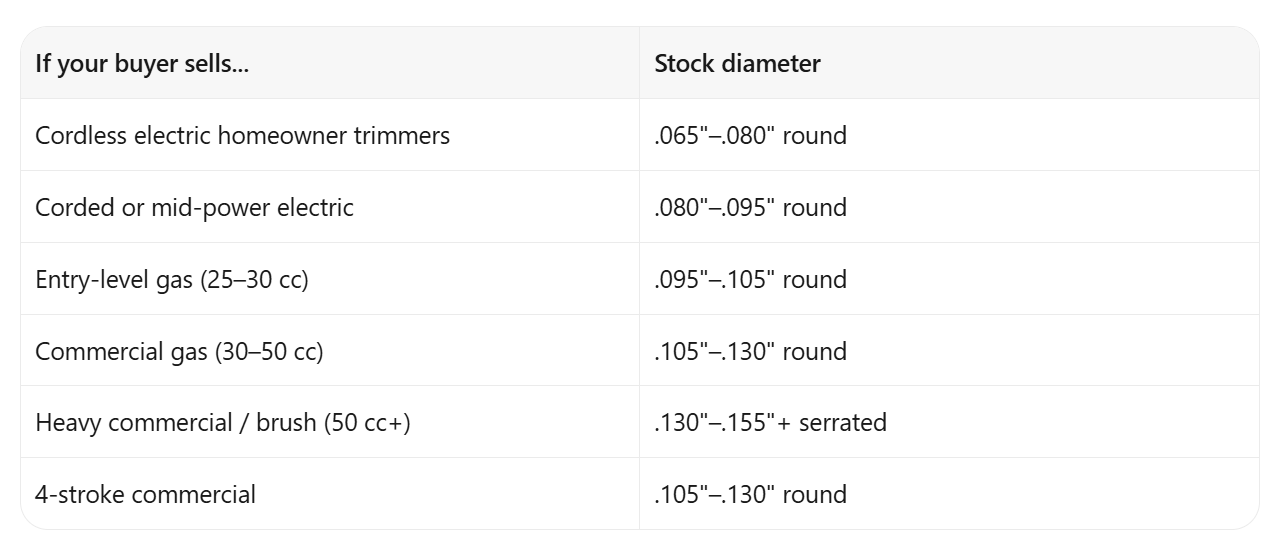
String Trimmer Line Diameter Guide by Tool Type
The Bottom Line
The wrong question is "what diameter is most popular?" The right question is: "What engine is my customer's end user running, and what diameter can that engine actually drive?" Pick by engine, not by "what's popular." Match diameter to power. Let shape follow from there. That's why we stock our catalog across four power bands — not because we want inventory complexity, but because the segments are genuinely different.
In the next article in this series, we'll cover quality testing — the batch-level checks that separate a reliable supplier from one who ships you a different product every season. Because once you've nailed material, shape, and diameter, quality consistency is what keeps your customers coming back.
Want the Full Diameter-to-Engine Matrix?
Contact our team for the complete one-page PDF reference and product portfolio across all four power bands.
Request Full Catalog & Diameter Matrix© 2026 Antanker OPE Parts. All rights reserved. | This article is part of the Trimmer Line Field Guide series for B2B distributors and sourcing professionals.